Lab Fermenter Manufacturer in Nepal
Dhruv Fabrotech is Leading Lab Fermenter Manufacturer, Supplier in Nepal
Lab Fermenter Manufacturer in Nepal – Dhruv Fabrotech
Dhruv Fabrotech, an India-based Lab Fermenter manufacturer operating from Pune, Maharashtra, designs and builds this equipment for research and industrial buyers, with the ability to control temperature, pH, dissolved oxygen, aeration, agitation, nutrient supply, and sterility throughout a fermentation run.
As a Lab Fermenter Manufacturer in Nepal, Lab Fermenter Supplier in Nepal, and Lab Fermenter Exporter in Nepal, Dhruv Fabrotech supplies laboratory-scale fermentation systems used across biotechnology, pharmaceutical research, microbiology, biofertilizer development, agricultural biotechnology, enzyme research, probiotic development, academic research, and bioprocess development.
Request a Lab Fermenter Quote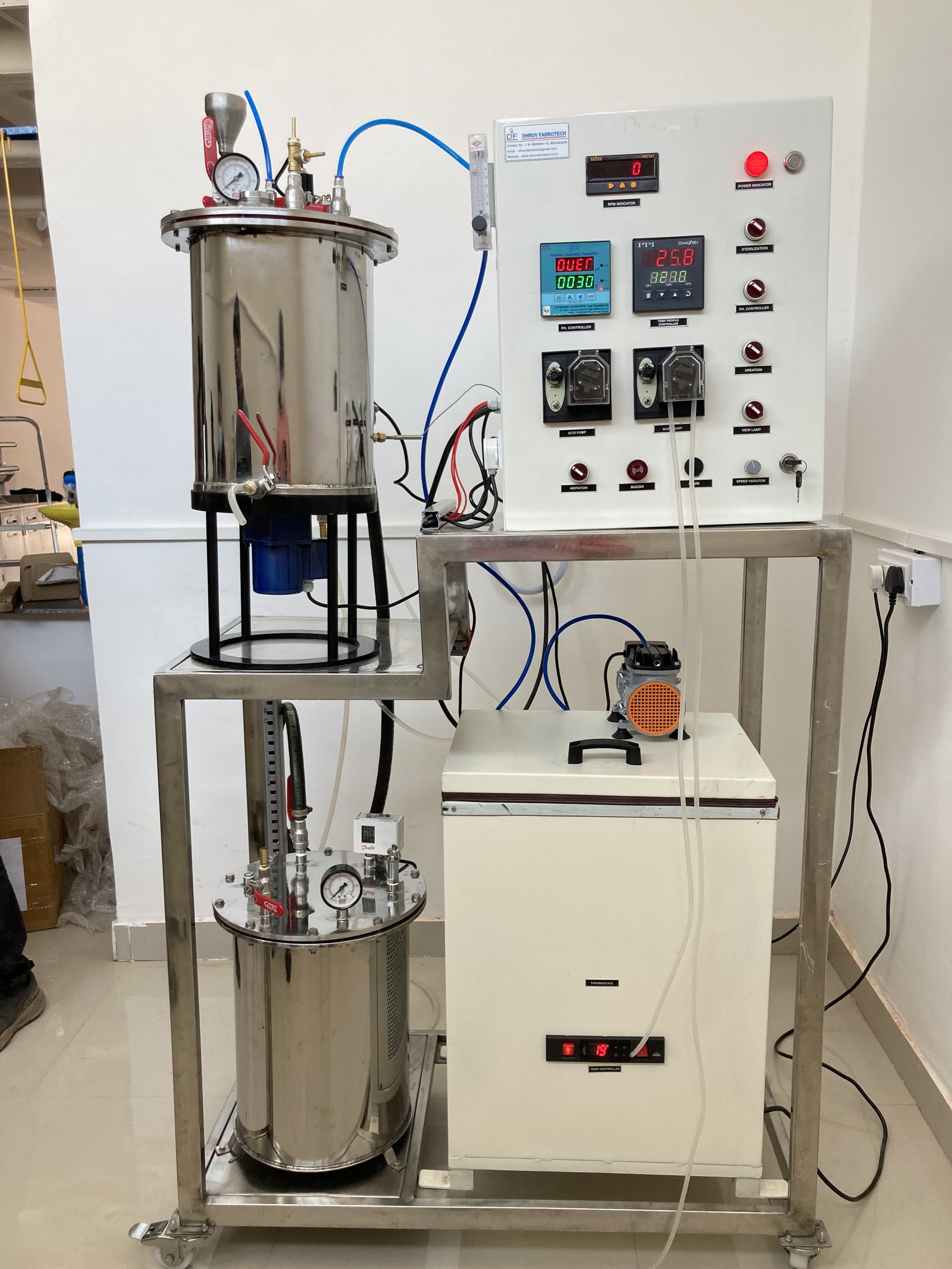
What Is a Lab Fermenter?
A laboratory fermenter is a compact fermentation vessel — essentially a laboratory-scale bioreactor — used to cultivate microorganisms, microbial cultures, or cells under controlled conditions. It gives researchers the ability to monitor and manage temperature, pH, dissolved oxygen, airflow, agitation speed, nutrient feeding, and fermentation time within a defined, repeatable environment.
Lab Fermenter Manufacturer in Nepal – Dhruv Fabrotech
Dhruv Fabrotech manufactures fermentation and biotechnology equipment in India and supplies laboratory fermenter systems to research organizations and commercial buyers in Nepal. The company's manufacturing experience spans laboratory fermenters, research-grade fermenters, pilot-scale fermenters, industrial fermenters, bio fermenters, bioreactors, and customized fermentation systems.
Technical Specifications of Lab Fermenters
| Category | Typical Range |
|---|---|
| Laboratory-Scale / Research-Grade Fermenter Capacity | Typically available in 3 L to 20 L |
| Pilot-Scale Fermenter Capacity | Bridging lab & industrial scale |
| Vessel Material Options | Borosilicate glass or Stainless Steel (SS304/SS316) |
| Controlled Parameters | Temperature, pH, dissolved oxygen (DO₂), aeration, and agitation |
| Automation Levels | Manual, Semi-Automatic & Fully Automatic (PLC-based controls where applicable) |
| Sterilization Options | Autoclavable or SIP/CIP sterilization support on select stainless steel models |
* Feature availability depends on model and process requirements — not every fermenter includes every feature listed above.
Types of Lab Fermenters We Supply to Nepal
Dhruv Fabrotech offers different laboratory fermenters to support research, microbial cultivation, process development, and scale-up studies.
Laboratory Scale Fermenter
Typically available in 3 to 20 liters, these fermenters are suitable for strain development, media optimization, microbial cultivation, and laboratory fermentation studies.
Research Grade Fermenter
Designed for controlled research, these systems provide monitoring and control of key parameters such as pH, dissolved oxygen, temperature, aeration, and agitation.
Glass Fermenter
Borosilicate glass vessels allow researchers to visually observe the culture during fermentation, making them useful for laboratory experiments and research applications.
Stainless Steel Lab Fermenter
Stainless steel fermenters offer a durable and hygienic solution for repeated laboratory batches. Depending on the model, SS304 or SS316 construction can be selected.
Automatic Lab Fermenter
These systems automate important parameters such as temperature, agitation, aeration, pH, and dissolved oxygen, reducing manual intervention during fermentation.
Semi-Automatic Lab Fermenter
Semi-automatic fermenters combine automated functions with operator control, giving laboratories flexibility during research and process development.
Customized Lab Fermenter
Dhruv Fabrotech can configure Customized Lab Fermenter in Nepal solutions based on capacity, vessel material, agitation, aeration, sensors, feeding and sampling ports, pH/DO monitoring, and automation requirements.