Fermentation Process Equipment Manufacturer in Nepal
Dhruv Fabrotech is Leading Fermentation Process Equipment Manufacturer, Supplier in Nepal
Fermentation Process Equipment Manufacturer in Nepal – Dhruv Fabrotech
Dhruv Fabrotech, an India-based fermentation process equipment manufacturer operating from Pune, Maharashtra, builds this equipment for buyers across biotechnology, pharmaceuticals, biofertilizers, agricultural biotechnology, enzyme production, probiotics, food biotechnology, microbial products, and research and development.
As a Fermentation Process Equipment Manufacturer in Nepal, Fermentation Process Equipment Supplier in Nepal, and Fermentation Process Equipment Exporter in Nepal, Dhruv Fabrotech manufactures its systems in India and exports them to biotechnology, pharmaceutical, agricultural, research, food-processing, and industrial buyers in Nepal, configured around each buyer's process and production requirement.
Request a Fermentation Equipment Quote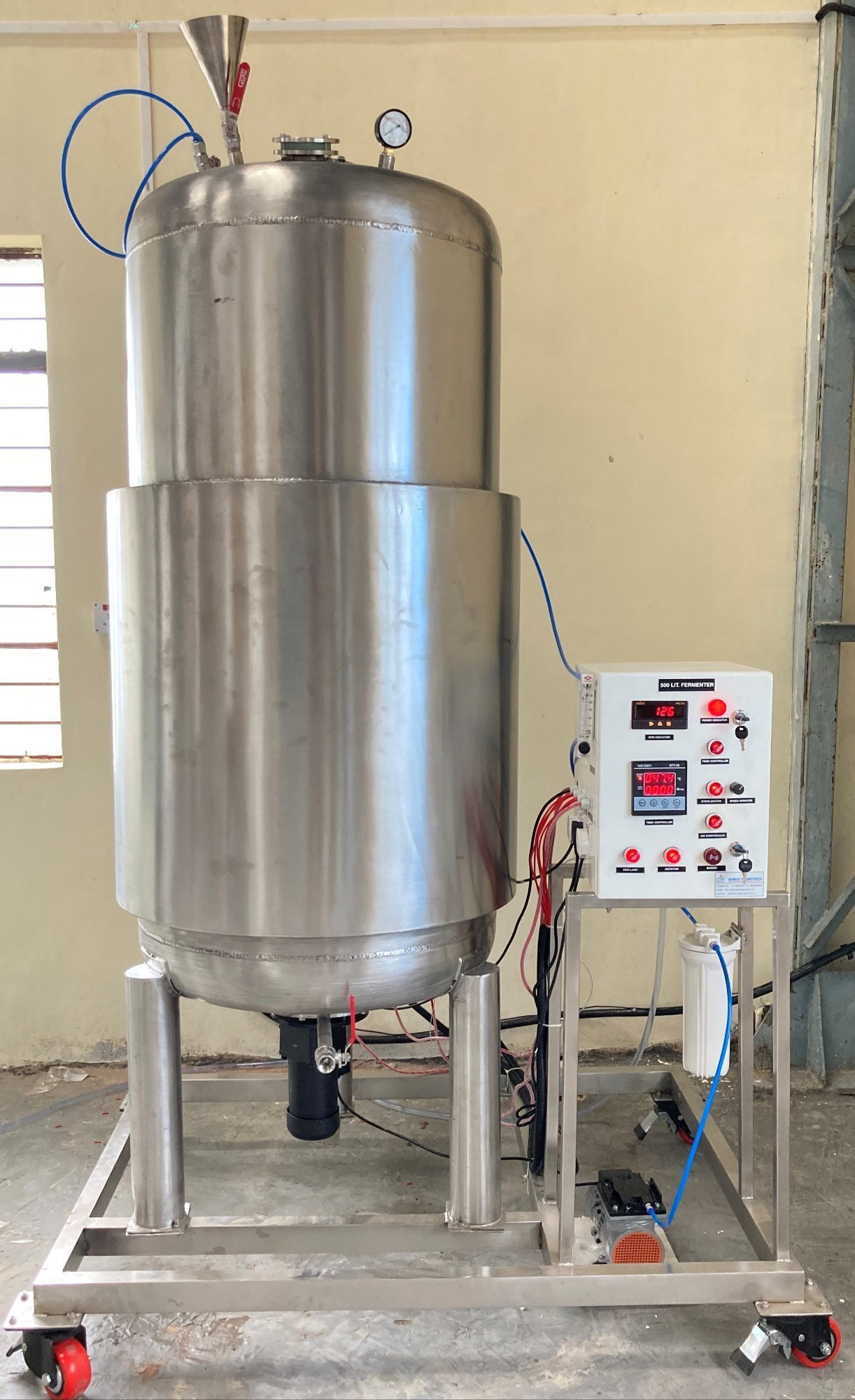
What Is Fermentation Process Equipment?
Fermentation process equipment refers to the group of machines, vessels, monitoring systems, and support equipment used to carry out fermentation under controlled conditions. A complete system may include a fermenter or bioreactor, process vessel, agitator, aeration system, sparger, temperature-control arrangement, pH sensor, dissolved oxygen sensor, sampling arrangement, feed ports, storage or holding tanks, control panel, automation system, and cleaning or sterilization system where applicable.
The actual equipment needed depends heavily on the process, target capacity, microorganism, and final product — a laboratory research setup looks very different from an industrial production line, even though both rely on the same underlying fermentation principles.
Fermentation Process Equipment Manufacturer in Nepal – Dhruv Fabrotech
Dhruv Fabrotech manufactures fermentation and biotechnology processing equipment in India for customers requiring laboratory, pilot-scale, and industrial systems. The company's expertise spans laboratory fermenters, research-grade fermenters, pilot-scale fermenters, industrial fermenters, bio fermenters, bioreactors, photobioreactors, biofertilizer plant machinery, stainless steel process equipment, and customized fermentation systems.
Buyers in Nepal can discuss:
Buyers evaluating a Fermentation Process Equipment Manufacturer in Nepal for their project can work directly with the Dhruv Fabrotech team before a configuration is finalized. The company manufactures in India and exports finished equipment to Nepal — it does not operate a manufacturing facility within Nepal.
Types of Fermentation Process Equipment We Supply to Nepal
Fermentation needs range from small research trials to full industrial production, so several equipment categories are available.
Laboratory Fermenter
Suited to research, microbial cultivation, media optimization, strain development, process testing, and academic laboratory work, with a strong focus on small-scale, accurately controlled fermentation. Laboratory-scale systems typically fall in the 3–20 liter range.
Research Grade Fermenter
Built for experiments requiring accurate monitoring and repeatable process conditions, with pH monitoring, dissolved oxygen monitoring, temperature control, aeration, agitation, sampling, and feeding available depending on configuration.
Pilot Scale Fermenter
Pilot systems help bridge Laboratory Development → Process Scale-Up → Industrial Production, supporting process validation, scale-up studies, trial batches, media optimization, and production planning before committing to full industrial equipment.
Industrial Fermenter
Industrial fermenters are designed for larger production requirements, with robust vessel construction, controlled agitation, aeration, temperature regulation, pH monitoring, dissolved oxygen monitoring, safety provisions, and process controls.
Bio Fermenter
Bio fermenters support microbial and biotechnology processes such as biofertilizers, microbial inoculants, agricultural biotechnology, enzymes, probiotics, and other biological products.
Bioreactor
Bioreactors provide controlled conditions for microbial, cellular, or biochemical processes, managing temperature, pH, dissolved oxygen, gas supply, agitation, nutrient addition, and process monitoring within a single vessel.
Photobioreactor
Photobioreactors are used for organisms requiring light, including microalgae, cyanobacteria, and other photosynthetic microorganisms. Applications include algae research, biomass studies, environmental biotechnology, and CO₂ fixation research (typically 2–20 liter laboratory scale).
Stainless Steel Fermentation Vessel
Stainless steel vessels, generally SS304 or SS316 depending on the model, support controlled fermentation and hygienic processing, with durability, easy cleaning, and suitability for scale-up projects.
Mixing & Holding Tanks
These tanks support media preparation, intermediate storage, blending, product holding, and process transfer between fermentation stages.
Customized Fermentation Process Equipment
Because every process is different, Dhruv Fabrotech builds Customized Fermentation Process Equipment in Nepal projects around capacity, process, organism, vessel material, agitator design, aeration requirements, sensors, temperature, pH, dissolved oxygen, ports, automation, control system, and future scale-up.
Technical Specifications of Fermentation Process Equipment
| Technical Parameter | Specification & Details |
|---|---|
| Equipment Scope | Laboratory, Research, Pilot-Scale & Industrial Production Fermenters, Bioreactors & Tanks |
| Working Capacity Range | 3L to 20L (Lab scale), 50L to 500L (Pilot scale), 1,000L to 50,000L+ (Industrial scale) |
| Material of Construction | High Borosilicate Glass (Lab) or SS304 / SS316 / SS316L Stainless Steel with Sanitary Polish |
| Vessel Jacket & Insulation | Single wall, Limpet/Dimple Jacket for steam/chilled water heating/cooling with mineral wool insulation |
| Agitation & Drive | Top/Bottom drive with mechanical seal / magnetic drive, Rushton / Pitch Blade impellers, VFD drive |
| Sensors & Control Loop | Temperature (PT100), pH, Dissolved Oxygen (DO), Antifoam sensor, Pressure & Level transmitters |
| Sterilization & Hygiene | Autoclavable glass, Steam-in-Place (SIP) and Clean-in-Place (CIP) with spray balls for SS models |
| Control & Automation | Manual, Semi-Automatic, or Siemens/Rockwell PLC with Color Touch Screen HMI & SCADA Data Logging |
Key Features of Fermentation Process Equipment
Features vary depending on the specific equipment type and configuration selected.
Main Components of a Fermentation System
The main process vessel where microbial or biological fermentation takes place.
Provides mixing and helps distribute nutrients, oxygen, heat, and microorganisms.
Supplies controlled air to fermentation processes requiring oxygen.
Distributes air or process gas through the fermentation medium.
Maintains process temperature using suitable heating/cooling arrangements.
Tracks and helps maintain the required acidity or alkalinity.
Monitors available oxygen during aerobic fermentation.
Allow controlled culture addition and process sampling.
Allows nutrients or process materials to be added where required.
Provides monitoring and control of selected process parameters.
May include pressure gauges, safety valves, and venting arrangements depending on vessel design.
Fermentation Process Control & Automation
Fermentation equipment is generally available in three operating configurations, depending on the model.
Manual Fermentation Equipment
Suited to processes where operators manually adjust and monitor selected parameters, offering full hands-on control.
Semi-Automatic Fermentation Equipment
Combines manual operation with selected automated controls, balancing operator involvement against convenience.
Fully Automatic Fermentation Equipment
Automates selected process parameters based on system configuration, including monitoring or control of temperature, pH, dissolved oxygen, agitation speed, aeration, process timing, feeding, and data monitoring where applicable. PLC or SCADA-based control is used where the specific model supports it.
Benefits of Fermentation Process Equipment
Controlled systems help maintain important fermentation parameters within required operating ranges.
Monitoring and automation can support greater batch-to-batch process consistency.
Closed and hygienically designed equipment supports controlled fermentation environments.
Proper agitation helps distribute nutrients, microorganisms, heat, and oxygen throughout the vessel.
Aeration and sparging systems help supply oxygen for aerobic processes.
Sensors provide information about pH, temperature, dissolved oxygen, and other parameters.
Equipment can support progression from laboratory trials to pilot and industrial production.
Manual, semi-automatic, and automatic configurations can meet different operating requirements.
Systems can be developed according to specific fermentation processes and applications.
Integrated process equipment can reduce unnecessary manual handling and improve process organization.