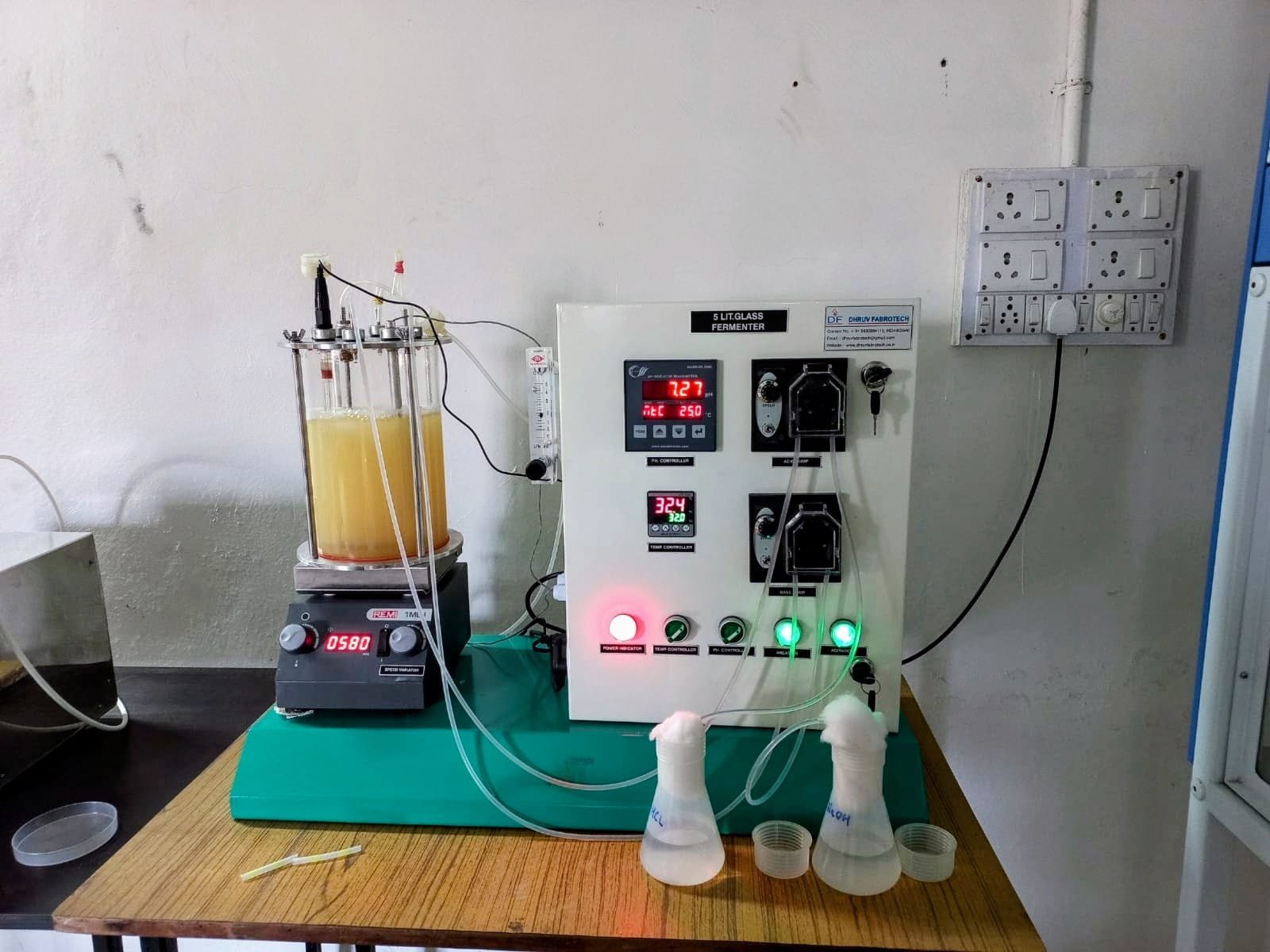
Dhruv Fabrotech, an India-based autoclavable glass fermenter manufacturer operating from Pune, Maharashtra, builds these systems with the ability to manage temperature, pH, dissolved oxygen, aeration, agitation, mixing, nutrient feeding, and fermentation time throughout a research run.
As an Autoclavable Glass Fermenter Manufacturer in Uganda, Autoclavable Glass Fermenter Supplier in Uganda, and Autoclavable Glass Fermenter Exporter in Uganda, Dhruv Fabrotech supplies systems used across biotechnology, microbiology, pharmaceutical R&D, biofertilizer research, agricultural biotechnology, enzyme studies, probiotic development, and academic research. Equipment is manufactured in India and exported to laboratories, universities, and biotechnology organizations in Uganda based on their working capacity and research application.
Dhruv Fabrotech manufactures laboratory fermenters, research fermenters, pilot fermenters, bioreactors, and related biotechnology processing equipment in India. The company can configure autoclavable glass fermenter systems for customers in Uganda according to:
| Parameter | Standard Specification / Option |
|---|---|
| Working Volume Range | 2 Litres to 20 Litres (Benchtop / Lab Scale) |
| Vessel Material | High-Quality Borosilicate Glass with SS316L Head Plate & Fittings |
| Sterilization Mode | Autoclavable Vessel Design (Sterilized via external autoclave) |
| Control Parameters | Temperature, pH, Dissolved Oxygen (DO), Aeration, Agitation, Feed Addition |
| Agitation System | Top-entry direct drive / magnetic drive with adjustable speed RPM |
| Aeration & Sparging | Ring / Micro-sparger, rotameter / Mass Flow Controller (MFC) |
| Automation Options | Manual, Semi-Automatic, or Fully Automatic PLC Touchscreen Control |
| Sensors & Ports | Temperature RTD Pt100, pH electrode, DO sensor, Level probe, Inoculation & Feed ports |
| Key Visual Advantage | Full optical transparency for observing culture growth, bubble distribution & foam |
Dhruv Fabrotech offers different glass fermenter configurations for laboratory research, microbial cultivation, and controlled fermentation studies.
Suitable for microbial cultivation, strain studies, media optimization, academic research, and bench-scale fermentation.
Designed for research requiring controlled monitoring of pH, dissolved oxygen, temperature, aeration, and agitation during fermentation.
Batch fermenters support defined fermentation cycles where nutrients and inoculum are added at the beginning. They are suitable for research trials, microbial studies, and process development.
Manual systems allow operators to control selected functions directly, making them suitable for basic research and educational applications.
These systems combine manual operation with selected automated controls, reducing routine monitoring while maintaining operator involvement.
Automatic configurations can control key parameters such as temperature, pH, dissolved oxygen, agitation, and aeration, depending on the model.
Dhruv Fabrotech configures Customized Autoclavable Glass Fermenter in Uganda systems based on working volume, agitation, aeration, pH/DO monitoring, feeding and sampling ports, sensors, and automation level.
Feature availability depends on the model and configuration selected — not every fermenter includes every feature listed below.
The transparent glass vessel lets researchers and students observe mixing patterns, bubble distribution, foam formation, and culture appearance directly.
The autoclavable vessel can be sterilized between research cycles following approved operating procedures.
Proper sterilization and closed fermentation conditions support cleaner experimental processes.
Important fermentation parameters can be closely monitored and adjusted during a run.
Controlled conditions help researchers perform highly comparable experiments over time.
Configurations can support different microorganisms and diverse research processes.
Lab-scale glass fermenters require far less space than industrial fermentation systems.
Small-scale fermentation allows experimentation without consuming industrial-scale quantities of media.
Researchers can evaluate different pH levels, temperatures, aeration rates, and agitation settings within one system.
Laboratory fermentation data can help support progression toward pilot-scale and industrial processes.
As a Glass Fermenter Supplier in Uganda and Laboratory Glass Fermenter Supplier in Uganda, Dhruv Fabrotech works with each buyer to match a configuration to their actual research process.
Delivery timelines are confirmed on a per-project basis once the equipment scope and destination are finalized.
Dhruv Fabrotech is an India-based manufacturer that can provide laboratory fermentation equipment for buyers in Uganda.
As an Autoclavable Glass Fermenter Exporter in Uganda, manufacturing takes place entirely at the company's Pune, India facility, with finished equipment exported for installation at the buyer's laboratory in Uganda.
Biotechnology laboratories, pharmaceutical R&D facilities, microbiology laboratories, universities, colleges, research institutions, biofertilizer manufacturers, agricultural biotechnology organizations, and biotechnology startups in Uganda can discuss their glass fermenter requirement directly with Dhruv Fabrotech. Share your research application, required capacity, microbial process, automation level, sensor requirements, sampling and feed needs, and project location in Uganda to receive a suitable technical and commercial proposal.
Dhruv Fabrotech is an India-based manufacturer, headquartered in Pune, Maharashtra, that supplies and exports autoclavable laboratory glass fermenters to customers in Uganda. It does not operate a manufacturing facility within Uganda.
It is a laboratory-scale fermentation system with a borosilicate glass vessel that can be sterilized in an autoclave, used for controlled microbial cultivation with monitoring of parameters such as pH, temperature, and dissolved oxygen.
Capacities are generally in the range of approximately 2 L to 20 L, depending on the model and configuration, based on Dhruv Fabrotech's product range for laboratory and research-scale systems.
Borosilicate glass offers transparency for visual monitoring, good thermal stability, and chemical resistance, making it practical for repeated laboratory fermentation cycles where researchers need to observe the culture directly.
Depending on configuration, these fermenters can monitor pH, dissolved oxygen, temperature, agitation, and aeration, giving researchers a controlled view of the fermentation environment throughout a run.