Autoclavable Glass Fermenter Manufacturer in Pune
Dhruv Fabrotech is Leading Autoclavable Glass Fermenter Manufacturer, Supplier in Pune
Dhruv Fabrotech is a Pune-based Autoclavable Glass Fermenter Manufacturer and Supplier, providing laboratory and research fermentation equipment for biotechnology companies, microbiology laboratories, pharmaceutical R&D units, universities, research institutes, biofertilizer organizations, and other scientific institutions across Pune and Maharashtra.
An autoclavable glass fermenter provides a controlled environment for microbial and biological processes at laboratory scale. Depending on the configuration, researchers can monitor and control parameters such as temperature, pH, dissolved oxygen, aeration, agitation, mixing, and feeding during a fermentation run.
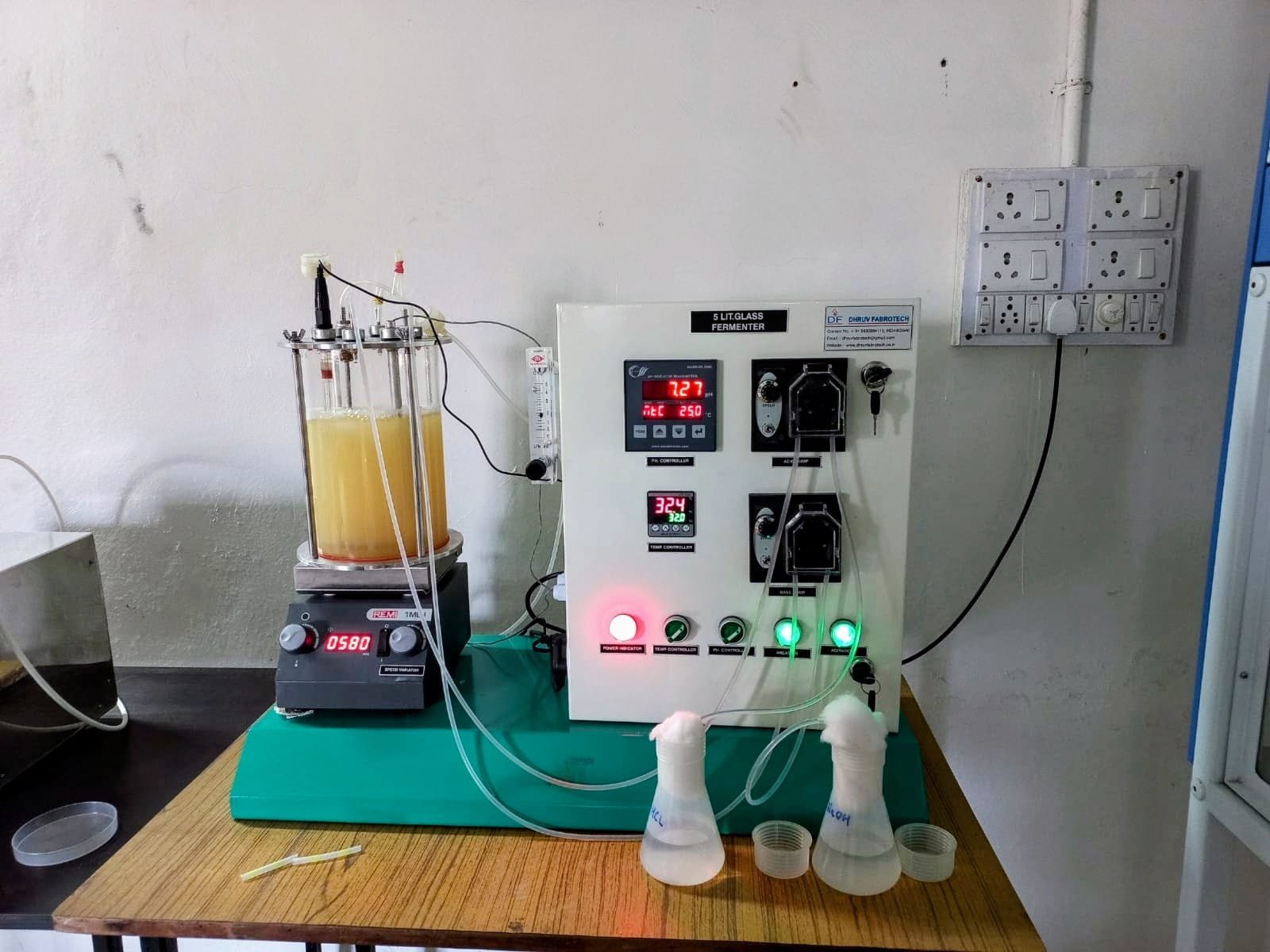
What Is an Autoclavable Glass Fermenter?
An autoclavable glass fermenter is a laboratory-scale fermentation system with a glass vessel designed to support sterilization through an autoclave when the selected vessel and configuration are suitable for that procedure.
The glass vessel provides a controlled space for cultivating microorganisms, microbial cultures, or other biological systems. Its transparent construction also allows researchers to observe the culture, mixing, aeration, and visible changes during the fermentation process.
Why Choose an Autoclavable Glass Fermenter?
Dhruv Fabrotech specializes in fermentation and biotechnology equipment for laboratory, research, pilot, and industrial applications. The company can configure glass fermenters according to the process instead of relying on one standard setup for every laboratory.
Customers can discuss their required working volume, biological process, vessel configuration, sterilization requirements, pH and dissolved oxygen monitoring, agitation, aeration, automation, and other technical requirements before finalizing the system.
Applications of Autoclavable Glass Fermenters
Autoclavable glass fermenters are useful in several areas where controlled laboratory-scale fermentation is required.
Biotechnology Research
Biotechnology laboratories can use glass fermenters for microbial cultivation, fermentation studies, strain research, media optimization, process development, and biological product research.
Microbiology Research
Microbiology laboratories can use them for microbial growth studies, culture development, fermentation experiments, and evaluation of different process conditions.
Pharmaceutical R&D
Pharmaceutical research facilities can use laboratory fermenters for microbial fermentation studies, process optimization, enzyme research, and early-stage bioprocess development.
Biofertilizer Research
Glass fermenters can support research involving beneficial microorganisms used in biofertilizer development. Applications may include culture development, media optimization, fermentation trials, microbial growth studies, and process evaluation.
Enzyme Research
Controlled fermentation conditions can help researchers study microorganisms involved in enzyme production and evaluate suitable process parameters.
Probiotic Development
Laboratory fermenters can support controlled cultivation and process studies involving probiotic microorganisms.
Agricultural Biotechnology
The equipment can be used for research related to biofertilizers, biopesticides, microbial products, and other biological agricultural applications.
Academic and University Research
Universities and colleges can use autoclavable glass fermenters for practical laboratory work, fermentation experiments, biotechnology research, student projects, and process-development studies.
Process Development
Research teams can use laboratory-scale fermentation systems to evaluate temperature, pH, aeration, agitation, dissolved oxygen, and other conditions before moving toward larger-scale equipment.
Salient Features of Autoclavable Glass Fermenters
Depending on the selected model and configuration, Dhruv Fabrotech autoclavable glass fermenters can include:
Not every feature is included in every model. The final specification depends on the application, working volume, sterilization method, process parameters, and required level of automation.
Benefits of Autoclavable Glass Fermenters
Easy Visual Observation
The transparent glass vessel allows researchers to observe the culture and visible process changes during fermentation. Mixing, aeration, foam formation, and culture appearance can be viewed without relying only on external indicators.
Convenient Sterilization
Where the selected vessel is designed for autoclaving, it can be sterilized according to the manufacturer's approved procedure before another research cycle.
Controlled Fermentation Conditions
Parameters such as temperature, pH, dissolved oxygen, agitation, and aeration can be monitored or controlled according to the selected configuration.
Repeatable Experiments
Maintaining defined process conditions helps researchers conduct comparable experiments and evaluate the effect of individual parameters on fermentation performance.
Efficient Laboratory Research
Laboratory-scale systems allow researchers to test different conditions using smaller quantities of culture media and other materials than larger production equipment would require.
Process Optimization
Researchers can study how changes in temperature, pH, aeration, agitation, dissolved oxygen, and feeding influence microbial growth and fermentation results.
Flexible Configuration
The vessel capacity, sensors, ports, agitation system, aeration arrangement, and automation level can be selected according to the research requirement.
Compact Setup
Glass fermenters are suitable for laboratories where space and working volume are limited. Their laboratory-scale design makes them practical for research, educational, and process-development environments.
Support for Scale-Up
Results from laboratory fermentation experiments can provide useful information for future pilot-scale and industrial process development.
Looking for an Autoclavable Glass Fermenter Manufacturer in Pune?
Contact Dhruv Fabrotech today to discuss your working volume, vessel configuration, sensor setup, and pricing details.
Contact Us Now